Tools to Find Your Target Market

What good is your product or service if no one knows about it? Think about all the hard hours you put into developing and brainstorming for your product. You do want that product to sell, right? Determining your target market is extremely crucial and can be a daunting task if you are not sure how to do it. There are a variety of ways and tools that can help you determine who may want to buy your product.

One tool that can be very helpful in figuring out who would buy your product or pay for your service is creating a persona. Up Close and Persona is a tool that allows you to create a sample profile of your perfect customer. You could also create a persona on your own. The sample persona describes everything about who your perfect customer is, what kind of activities they participate in, where they work, how many children they have, the type of personality they have, etc. The profile of this fictitious customer will allow you to determine if they would actually buy your product and why they would buy your product. The purpose of creating a persona is to understand your customers and how they think. Below is a persona template. The template asks you to put in a photo of your perfect customer, their basic demographics, and psychographics.
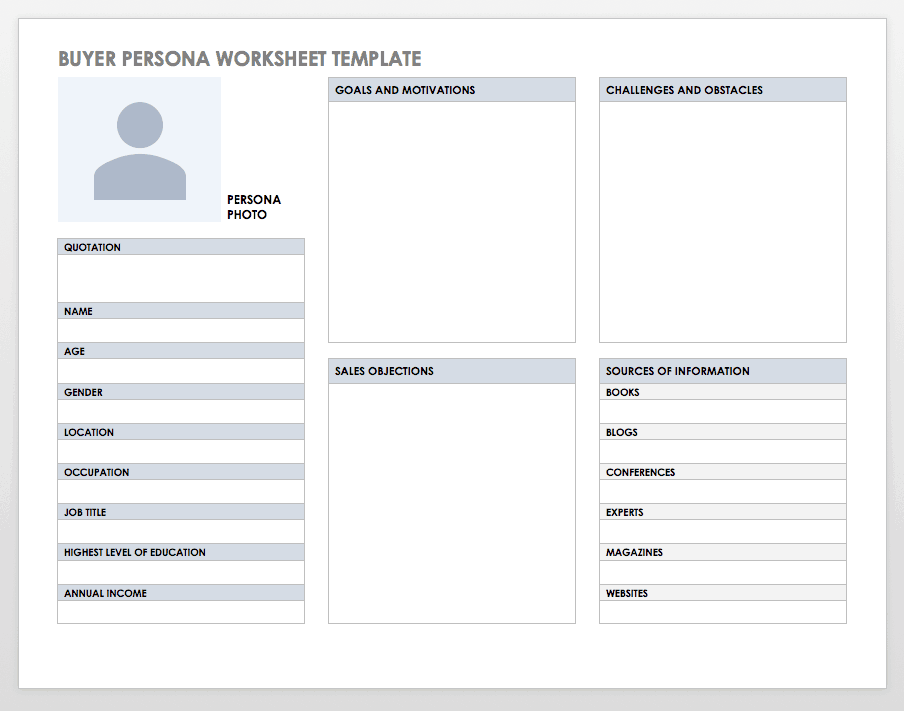
Image result for persona template

(Weller, 2018)

Another helpful tool that can be used in determining your target audience and specific segments is Google Trends. This tool offered by Google allows you to see what words are trending and who is searching these words. For example, you could search “smartphone” and it would show you on a map where the most searches are coming from. It would also show you words related to smartphones that other people are searching. You can also search more than one keyword at a time to compare the numbers on a graph if you are more into the visuals. Google Trends would allow you to see what categories your audience is interested in. If used in reverse, you can determine where your target audience lives just by the number of searches in any given area. The tool is not limited to the United States. It will show you results from all over the world. If you are limiting your product to your surrounding area or country, there may be other markets that you are not tapped into yet. You may be advertising your product mainly in Los Angeles because of the high population, but two cities over with a slightly smaller population may be looking at products similar to your’s more closely.

google trend example.PNG

(Google Trends, 2020)

In the photo above, I searched the words smartphone, Android, and Apple. The graph shows that a considerably larger number of people search for “Apple” than they do “smartphone”. Because smartphones are widely used today, the smartphone companies are searched heavily all through the country.

There are certainly a lot more ways and tools that can be used to determine your target audience. There is no right or wrong tool to use. You just have to choose one and start there!


Resources:

Google Trends. (2020). Trend results: Smartphone, Apple, Android. Google Trends. Retrieved from https://trends.google.com/trends/explore?geo=US&q=smartphones,android,apple

Weller, Joe. (2018). Easy Steps to Create a Buyer Persona Using Free Customer Profile. Smartsheet. Retrieved from https://www.smartsheet.com/customer-profile-persona-templates


Social Media Usage in My Life

Social media is a large part of most peoples’ lives. It is the blue app on your home screen of your smart phone. It is what you go to when you’re bored for entertainment. It is what has consumed our youth’s attention. I use quite a few forms of social media in my life and each are used for different reasons. First, I use Facebook to keep up with my friends and family. Most of my family is about five hundred miles from me, so I like that I can watch their posts and see what they’re up to. I also use Facebook messenger to communicate to almost everyone I know. I like Messenger because it shows that the message was sent and delivered. It shows that my family member or friend got my message. I use Instagram, as well. I have a personal account that I don’t post on very often and I have an account for my artwork. Depending on my mood, I’ll switch from one account to the next to see different posts. My art account is following tags and other accounts purely related to art and the different methods and techniques. My personal account is following makeup posts and tags related to happiness, health, and marketing. I also use Yahoo Mail to keep up with my emails. I get emails from a lot of mobile apps and websites alerting me when things have changed or when something is on sale.

While I use a lot of different social media platforms, I do not like them 100%. I hate that Messenger shows when you’re active – I know this feature can be disabled – because it can cause issues. “I thought you said you were going to bed.” “I thought you said you were getting off Facebook.” That green little dot is not always accurate but people tend to believe it. Instagram is a great platform for promoting a product or service and nothing else (in my opinion). Sure, you can send messages and leave comments, but what is really the point in only sharing a photo? Instagram is owned by Facebook and Facebook has all the features of Instagram plus some. I like the idea of social media, but it has consumed us so much that some people don’t have much of a life outside of it. You can have 2,000 friends on Facebook, but only 10 of those are real, genuine friends.

Consumer Engagement with Coca-Cola

Coca-Cola is one of the largest and widely known brands in the market. They are an international beverage company and compete directly with PepsiCo. Currently, the company is actively pursuing an ethical reputation by giving scholarships, replacing clean water, and improving health aid for HIV and Aids (UK Essays, 2016). However, the company has not always been out of hot water.

In 1999, nearly two thousand employees of Coca-Cola sued the company due to racial discrimination (UK Essays, 2016). The African-American community within the company felt they were being paid far less than the Caucasians – about $26,000 less. While the company denied the truth behind the allegations, Coca-Cola paid $193 million to settle the lawsuit and formed a diversity council to improve their reputation and prevent further issues from arising (UK Essays, 2016). While Coca-Cola lost some sales after the lawsuit, the company claims to not have lost any revenue (Schafer, 2000). The victims who filed the lawsuit said that the company failed to monitor their managers and supervisors, which led to one woman being verbally insulted, and others facing lower salaries, promotions, and production evaluations. Some of the accusants still do not purchase or consumer the company’s products (UK Essays, 2016). Even though Coca-Cola denied the allegations, it sent a strong message to the company. They spent about $36 million to establish a committee to monitor their employment practices (Schafer, 2000). Making the changes to their policies and committees showed the world and African-American community that they will not tolerate unlawful activities, especially involving racial discrimination.

The law clearly states any form of racism during employment is not acceptable and includes less pay, less promotions, hiring, firing, and harassment in the workplace (Thompson, 2019).  Coca-Cola should have had an anti-discriminatory policy in place to ensure employees were not subject to the hate crime. Specifically, the company could have posted their policy publicly so that stakeholders and potential employees could see where the company stood in terms of discrimination (Thompson, 2019). Having the policy posted publicly would show the world they are a transparent company and that they have nothing to hide. The company could also have had the diversity committee already in place. The diversity committee could have prevented the lawsuit if the victims could have come forward anonymously to report their experiences. The committee could have then handled the issue seriously and investigated the claim. Also, Coca-Cola should have made it clear to their employees that discrimination is never acceptable by requiring new-hire meetings that talk about these policies and the consequences of termination (Bartiromo, 2013). Setting the tone for new employees is critical if the company wants them to know what is acceptable and what is expected of each employee.

In conclusion, Coca-Cola is now a great company that practices methods that are socially and environmentally friendly. Companies of all shapes and sizes can be accused of unlawful discrimination, but could easily investigate and handle the allegations if they truly are taking every measure to ensure their employees are not subject to hate crimes by coworkers, managers, or owners. The lawsuit filed by the African-Americans who claimed they were not being treated right certainly got the company’s attention considering Coca-Cola made adjustments to their policies and established a diversity committee to oversee and manage employment practices.

Resources:

Bartiromo. (2013). Preventing Race and Color Discrimination in the Workplace. HR 360. Retrieved from https://blog.hr360.com/bid/141592/Preventing-Race-and-Color-Discrimination-in-the-Workplace

Essays, UK. (November 2018). The Coca-Cola Company Struggles with Ethical Crises. Retrieved from https://www.ukessays.com/essays/business/the-coca-cola-company-struggles-with-ethical-crises-business-essay.php?vref=1

Schafer. (2000). Coke to Pay $193 Million In Bias Suit. Washington Post. Retrieved from https://www.washingtonpost.com/archive/politics/2000/11/17/coke-to-pay-193-million-in-bias-suit/6a43c0c7-dcde-4d8c-a95f-3fe57c508c85/

Thompson. (2019). How to Prevent Racism in the Workplace. Chron. Retrieved from https://smallbusiness.chron.com/prevent-racism-workplace-10258.html


Importance of Brand Positioning

Imagine you’re driving down the interstate and you look over to find cows painting “Eat mor chikin” on a billboard. Did your mouth just water? Did your stomach just growl?Mine always does when I think of Chick-fil-A! Also, did you know that the color red stimulates your feelings of hunger (Artitudes Design, 2017)? Yep! The color that is used widely by many restaurants, gas stations, and shopping centers is incorporated in their logo to capture your attention! How sneaky!

Chick-fil-A is my favorite fast food restaurant because of their customer service and quality food. Their great food is also a bonus! They have successfully established a positive brand position within the restaurant industry by standing out in the crowd. The corporate office’s purpose is “To glorify God by being a faithful steward of all that is entrusted to us and to have a positive influence on all who come into contact with Chick-fil-A” (Chick-fil-A, 2019).  They are a Christian-based company and use their faith when making any and all business decisions (Stevens, 2014). Because the company strives for over-the-top customer satisfaction and provides higher quality food than just burgers and fries, Chick-fil-A’s brand has a positive image with many, many Americans. Specifically, they have become more successful than KFC (Stevens, 2014)! The company’s goal is to cater to customers while providing excellent dining experiences and being friendlier and healthier than their competitors. Chick-fil-A believes that a positive dining experience leads to a higher number of customer returns. I know when I see the cows painting on a billboard my mouth starts watering for their nuggets and variety of dipping sauces!

The brand seems to do everything the right way with their customers’ needs always in mind. One example of what they have done right when branding their company is adhering to their religious roots when making important decisions. They strive to do good by working for God. They observe Sundays as a day of rest for their employees and they donate to over 700 charities (Stevens, 2014). However, I do think the restaurant needs to build on their socially-responsible reputation. They should limit the amount of plastic used by switching to paper straws and condiment pumps. Making a few changes in how they impact the environment could help the company gain another target audience – the environmentalists and those who follow the “eco trend” established on social media. Overall, the company’s strategies involve excellent customer service, higher quality food, friendliness, and social responsibility.

Resources:

Artitudes Design admin. (2017). Red in Marketing – Color Psychology.  Artitudes Design. Retrieved from http://www.artitudesdesign.com/red-color-psychology/

Chick-fil-A. (2019). Who We Are. Chick-fil-A. Retrieved from https://www.chick-fil-a.com/About/Who-We-Are

Stevens, JL. (2014). Successful Brand Positioning: Chick-fil-A. WordPress. Retrieved from https://crisismanagementsolutions.wordpress.com/2014/03/13/successful-brand-positioning-chick-fil-a/


Tesla: Green for Profit or Environment?

Elon Musk is the founder and owner of Tesla and many other environmental-friendly and technological companies. The main priority of Tesla is to provide an automobile that is extremely smart, safe, and not harmful to the planet. Tesla’s website clearly states their intentions of developing new designs and the legal guidelines they follow while conducting business. As a business, Tesla and Elon hold a responsibility to maintain social and ethic standards. Elon Musk designed the company’s policy to constantly monitor their vendors and suppliers to ensure legal issues do not arise. The company will not conduct business with any company that is involved in any illegal activity such as human trafficking, child labor, and slavery (Tesla, 2019). Materials purchased from vendors are also analyzed to ensure they aren’t sourced legally or from countries that could cause conflict.

Many do not know that Tesla does not only manufacture automobiles, but also produce their own car batteries, energy banks, and solar panels. The batteries were once manufactured by a third party but Elon developed an efficient way to produce their own, which helped create many jobs in the area. The energy banks and solar panels can be purchased by the average Joe for his home, by owners of small companies, and by CEOs of large companies and even electric companies. To encourage consumers to purchase more energy efficient cars like Tesla, Tesla and the government offer tax credits for certain designs and for usage of solar panels in homes and businesses. Elon Musk also made his patent for the Tesla cars available to the public (Morris, 2018). Providing the patent to the public allows other companies to evaluate and potentially improve the designs to make more efficient and safer cars in the future. This shows he is not in the business solely for profit, but also because he genuinely cares for the condition of the planet. Tesla also provides exceptional benefits, compensation, and leadership programs to their employees. Overall, Tesla is socially responsible in regards to the environment, their community, their customers, their shareholders, and their employees. Elon and his company genuinely care for the environment and he continuously proves this to the world as he works on SpaceX, The Boring Company, and many other “projects” he spends his spare time on.

Unfortunately, companies will always get backlash from their customers claiming they are neglectful or greedy for profits. In 2018, an eighteen year old boy crashed his Tesla going 116 mph in Florida and died due to the impact and the car battery catching fire (Farivar, 2019). The boy’s family and lawyer claimed Tesla removed the speed governor during a maintenance servicing that was installed in the car and did not let the parents know they removed it. The family and lawyers also states Tesla was neglectful to the fact that their car batteries are dangerous and should be covered better to prevent them from catching fire. While Tesla did not admit to neglect, the company did launch an update to control driving speeds via Tesla app. Tesla’s spokesperson did apologize for the family’s loss, but in reality, no car crash involving such high speeds could have ended safely no matter what type of car was used.


Sources:

Farivar, Cyrus. (2019). Tesla sued after fatal crash, accused of making “unreasonably dangerous” car. Ars Technica. Retrieved from https://arstechnica.com/tech-policy/2019/01/tesla-sued-after-fatal-crash-accused-of-making-unreasonably-dangerous-car/

Morris, Duane. (2018). A Closer Look at Tesla’s Open-Source Patent Pledge. Lexology. Retrieved from https://www.lexology.com/library/detail.aspx?g=ca6c332f-2cc5-401b-b80d-36473d0754c7

Tesla Editors. (2017). Legal. Tesla. Retrieved from https://www.tesla.com/about/legal

Brand Rivalry & Their Strategy

When comparing brands, it isn’t difficult to identify which companies are in direct rivalry- such as Coca-Cola and Pepsi, Visa and Mastercard, and Marvel and DC. Each rival company provides very similar product and services as the other, which means they are always competing for top position in the market.

Two of the largest toy and game board companies are Hasbro and Mattel. They both produce iconic toys for children of all ages, but Hasbro provides more and to a larger audience. Hasbro manufactures toys, games, video games, movies, and television shows. The company’s brand strategy was designed to create immersive experiences for children using stories developed around their micro-brands such as My Little Pony and Transformers (Hancock, 2010). Children are able to play with figures of their favorite characters while watching the television show, thus creating a physical and emotional experience. Through the creation of motion pictures and television shows, Hasbro was able to attract more than just children to their brand. Transformers: The Last Knight was released in 2017 and the trailer alone scored over one hundred million views within two days (Agar, 2016). Parents, children, and teens are interested in Transformers due to its clean and entertaining humor and action-packed them, which draws in more of an audience for Hasbro.

On the other hand, Mattel is an applaudable company because they focus more towards providing educational fun to young children to help develop motor and cognitive skills (Clark, 2017). Their micro-brands are very popular among the younger age groups, such as Hot Wheels®, Fisher-Price®, and Barbie®. Mattel is the underdog in this race due to their audience being significantly smaller than Hasbro’s audience. The company does produce figures and toys for other companies such as Minecraft and WWE, but is not the creator of the brands. To gain more market share, Mattel needs to focus on gaining more of an audience. This can be done a number of ways:

  • Re-invent an existing micro-brand to appeal to a broader demographic (such as higher age groups)
  • Launch a new micro-brand that appeals to parents, young children, and teens – Parents are more likely to sit through a film with their child if the film is somewhat of an interest to them as well. Pixar and Disney have done well with creating movies that are bright, colorful, and entertaining to children while sending an overall message that parents are interested in as well.
  • Start a television series revolving around their existing and beloved brands – which is what Mattel announced last month they are planning (Cook, 2019).
  • Launch a campaign designed around digital media and technology to attract older children and young teens.
  • Launch a campaign directed towards current generations – Generation X and Millennial

Overall, Mattel would have to increase their content output and increase their audience size to pass Hasbro in the race. Personally, I prefer Hasbro over Mattel because I can recall as a child playing a lot of their games. It brings back fond memories of sitting together with my family and enjoying quality time with them – technology has majorly taken that away from us since then. I still play their older games such as Jenga, Clue, Yahtzee, and Connect4 occasionally. I believe most consumers prefer Hasbro over Mattel because it is a more family-oriented company. Their brands appeal to more than one demographic and are available through many platforms (games boards, actions figures, television, game shows, etc.)


Sources:

Agar, Chris. (2016). “Transformers: The Last Knight Trailer Passes 100 Million Views In 2 Days.” Screen Rant. Retrieved from https://screenrant.com/transformers-5-last-knight-trailer-views/

Clark, Alex. (2017). “Mattel Unveils Plan to Reinvent Company and Deliver Enhanced and Sustainable Growth.” Mattel. Retrieved from https://news.mattel.com/news/mattel-unveils-plan-to-reinvent-company-and-deliver-enhanced-and-sustainable-growth

Cook, Dena. (2019). “Mattel Announces A Slate Of 22 Television Shows For Multi-Platform Distribution.” Mattel. Retrieved from https://news.mattel.com/news/mattel-announces-a-slate-of-22-television-shows-for-multi-platform-distribution

Hancock, Debbie. (2010). “Hasbro Outlines Branded Play Company Blueprint at Annual Investor Day.” Hasbro. Retrieved from https://investor.hasbro.com/news-releases/news-release-details/hasbro-outlines-branded-play-company-blueprint-annual-investor 

What Type of Consumer Are You?

When thinking of consumers, you usually think about people who buy goods or services for you or a company. But what type of consumer are you? There are two types of consumers in the marketing industry – individual and organizational. An individual consumer is someone who purchases goods for their own well-being or use. Organizational consumers are those who purchase goods to resell to other consumers for a profit. As a regular person, most people tend to buy necessities such as food, toiletries, and clothing. All of these items are for personal use. However, organizational consumers are mostly companies or entrepreneurs who need the basics to grow a company and produce their good or service for others. For example, McDonald’s buys cups, frozen food, trash bags, sanitizing chemicals, and etcetera to provide a service to other consumers.

Personally, I am an individual consumer – for the most part. I buy food for myself. I buy clothes for myself. I buy gas for my car to drive around for leisure activity. I buy shampoo to wash my hair. I don’t resell any of those products or use them in order to make a profit in any way. However, I have recently started going to Gimme 5 every Saturday. Its a cool little place that is locally based here in the Nashville area that buys overstock and returns from Amazon then sells each item for five dollars. They slowly reduce the price of the remaining inventory every day of the week until they throw it all out Friday night and get in new inventory. I have found some pretty cool items such as an Ancestry DNA kit. I resold it for $45 on eBay. Today, I sold a bottle of testosterone pills for $49! Remember that I originally only paid five bucks for each item! That makes me an organizational consumer.

When I need to make a purchase, I don’t think too much about the item or which brand I buy depending on how much I need the item. If it is just necessities such as toiletries, I purchases whatever brand I know is decent and has the best price per unit. I don’t do further research on the item. On the other hand, I tend to research different types, brands, colors, options, sizes, locations and prices of an item that I don’t really need. For example, I really wanted a bookshelf to house my new collection of cookbooks. I looked around a few different stores comparing colors, sizes, and prices before I made a purchase. I eventually chose a bookshelf that was only about $30, it was taller than me, it was black, and it was the perfect size for the space I wanted it in. I wasn’t willing to budge much because I didn’t need it. If the purchase is bigger than a small piece of furniture, I spend a lot of time on the internet trying to find the best option and price by reading reviews and comparing websites. In the end, what makes my final decision is that I want to spend my money to its fullest potential ( I don’t want to buy a lumpy, hot mattress or a car with a hundred factory recalls)!

The marketing aspect of items does get my attention while in the store, but it does not lead to my final purchasing decision. For example, I might find myself wandering to the furniture section if I see a trendy or fluffy recliner on display. However, if that recliner is three times the price of the one they offer on their website or the plain brown recliner I saw at WalMart that was electric, had a folding side table attached, had adjustable speakers, and was electric, I would definitely chose the cheaper one because it is more functional and more worth my money.

After a long day of contemplating deals and spending my hard-earned money, I do tend to feel a little regret – even about the groceries I bought! I can’t help but think I might have been able to save a little bit if I had purchased only the generic brands. The next day when I’m digging through the cabinets trying to find something to cook for dinner, I start to feel a sense of accomplishment. I am thankful that I was able to work to make the money to purchase the food. I am thankful that I can afford groceries a many people cannot. I am thankful and proud that I did not have to use some sort of assistance because I have someone whom I split bills with and can afford to buy all of the groceries we need twice a month. I tend to feel the most guilty when I make a rash purchase on eBay or Amazon. Usually, I’m bored and scrolling through social media feeds, see something cool, search it on eBay, and will buy it if its less than $10. “It’s only a few bucks. It won’t hurt,” is what I tell myself for all of these little transactions. By the time its time to get paid again, I try so hard to think where $100 went. “Oh,” I think, “Funko Pops on eBay,” as I shake my head in disappointment. The biggest marketing technique on eBay that makes a sale final for me is if the price is below $10 or $15 and if the price ends in $.99. Something about the price not being completely rounded up to that next whole dollar tricks my brain into thinking, “It’s only $4.99, not $5.00.”

Resources:

Kardes, F. R., Cronley, M. L., & Cline, T. W. (2013). Consumer Behavior (2nd ed., EBook). doi: https://mbsdirect.vitalsource.com/#/books/9781305161689/cfi/3!/4/4@0.00:18.2

Under Armour’s Marketing Segments

Within a little over two short decades, Under Armour expanded extreme amounts just by altering who they sold their products to. The company started out as very small, only sold shirts to wear under football gear, and only targeted strong, athletic, and sweaty men. Later, shorts, hats, and shoes were added to the Under Armour line. The increase in total sales but low and steady rate of sales among women made founder, Kevin Plank decide to launch a line designed specifically for women in 2013. It worked! He was able to bring up the total sales and the sales brought in my women.  The campaign was called “I Will What I Want” and essentially showed women they could do whatever they set their minds to because we are powerful. The campaign brought in a 42% increase in traffic on their website and led the company to #2 on the list of sportswear market, just above Adidas and below Nike (Harvard Publishing, 2016.)

The campaign was so successful because the company targeted a relatively large group of consumers who make up a good portion of the population. Under Armour also used celebrities to endorse their products. Consumers like to see their favorite sports player wearing the brand. Also, the company used their social media sites to market and advertise their new line of products. Eventually, products start to advertise themselves through word-of-mouth. Personally, I tell everyone I know and my grandma when I find a perfect piece of clothing. Because the product was already focused on sports and athletic individuals, adding women to the mix created many different targeting segments for the growing company. For example, now the company can promote products specifically to women in general, women who play sports, women who weight-lift, men who play sports, men who weight-lift, anyone who is adventurous and needs a new rock wall-climbing outfit, and people (most likely women) who just think the outfits are cute.

It is important for any company when creating new segments in their target audience that not everyone wants or can afford the main product. Apple launches a new phone every year and they just get more and more expensive. Yes, they’re cool and look pretty, but I can’t afford one unless I sign a contract with Verizon and pay an arm and leg every month. Products must be directed towards those who are most likely to make the purchase. Here in Tennessee, Bass Pro Shop and Cabela’s are popular because hunting and fishing are popular activities in the area. In the coastal states, consumers are more likely to make water-related purchases. With that being said, the company must ask and answer many questions:

  • Who wants this product?
  • Why would they want this product?
  • Who can afford this product?
  • Do they need or want this product?
  • Are there similar products that I need to compare it to?
  • What store would be the best to launch the product?
  • What state/city would be the best geographical location to launch the product?

I could go on and on with the questions, but you get my point. Your opponent must be strategically placed on the chess board.

One example of marketing segmentation is Coca-Cola releasing alternatives to their classic soft drink. Diet Coke was released for those who are watching their sugar intake. Coke Zero was released to taste more like the classic and less like a diet drink. They even released a Coke sweetened with Splenda for those who like that taste. Eventually, Coca-Cola launched a line of flavored coke – both in classic and diet. My favorite is the cherry flavor and the vanilla flavor. Coca-Cola then decided to turn in a whole new direction and create another segment by creating other soft drinks, like Sprite and Fanta. Well, some people don’t like soda. Okay, enjoy a Dasani, Minute Maid juice, Powerade, Gold Peak Tea, or Vitamin Water. The company has put their eggs into so many different baskets that even if most of the baskets crushed their eggs, the company would still thrive!

Lately, I’ve noticed quite a bit of interest in the Keto diet from my friends and on my social media accounts. The Keto diet is different than all other diets because you are mainly consuming fats – which is something we were always taught was bad for us. However, I think Coca-Cola, or another popular soft drink company, should launch a Keto-friendly soda or juice and promote it towards those who are passionate about fitness and health (and those who are just following the fad). The soda or juice should contain vitamins, protein, and maybe fat. A lot of people love juice and it offers many health benefits such as antioxidants and vitamins, but they all contain just as much sugar as a Coke! Therefore, juice is NOT Keto-friendly and most people who are on a diet of any sort cut juice immediately. Coca-Cola could design a campaign designed around fitness, but not specifically Keto because it may just be a fad and the diet is extremely hard to stick with if you aren’t educated on it. They should promote the new product and their diet products to those who are dieting or just are conscious of what they consume. The fitness campaign could be advertised on all social media accounts and sold in convenient stores, restaurants, and gyms all over the world.


Sources:

(2016, July 27). Under Armour’s Willful Digital Moves. Https://hbsp.harvard.edu/download?url=/courses/592073/items/UV7147-

The Coca-Cola Company. (2019). What’s the difference between your colas – Coca-Cola, Diet Coke, Coke Zero and Coca-Cola Life? Retrieved from https://www.coca-colaproductfacts.com/en/faq/brand/four-cola-difference/


Ethical Practices in Marketing

When entering the marketing world, it is important to keep in mind the legalities of advertising a product. The number one rule is to do no harm to consumers. Ethically and legally, it is not okay to lie to consumers to get them to buy your product. Lying only leads to mistrust and a loss of customers. As part of this policy, remain honest and transparent. Lie about nothing. Tell the truth about your product no matter what. Stand behind your product and have faith in your product. With that being said, it is important to take full responsibility for anything that may happen or if your product does not live up to expectations. Consumers respect a company that loves their own product and is very honest. As a salesperson or part of a marketing group, it is very common to come across opportunities to use questionable tactics to gain consumers. NEVER participate in tactics such as price gouging. Obviously, harassment is never acceptable with any company and not legally or ethically accepted with individuals. Participating in any form of harassment or questionable tactics can lead to legal action and can result in charges and/or time served depending on the severity of the accusations. If you have to ask yourself “Is this okay,” it probably is NOT! Ask yourself if you would purchase from a company that lies or clouds their answers with useless information. Remaining transparent with customers and the public reassures consumers that the company is honest and would not sell a faulty product. Overall, the consumers are the life of the company and the company would not exist without customers purchasing the products. Your success relies heavily on how you react to legal and ethical situations.

Just remember to stay honest, humble, and responsible. Give back to your community. Be mindful of the resources you’re using. If you’re using a bunch of paper, plant a tree.. Be respectful to the environment around you, your planet, and more importantly…your customers!

When not following the advice above, I’m afraid you are asking for legal/ethical trouble and maybe even failure of your company. Consumers rely on their companies to remain truthful and to give them useful products. Give them products that work. Don’t charge a ridiculous amount for something made of cheap wood and plastic. Don’t verbally, physically, or emotionally harass ANYONE ever. And just remember the key policy in the marketing world… Do no harm.

Happy sales!

Resources:

American Marketing Association Editors. (2017). Statement of Ethics. Retrieved from: https://www.ama.org/AboutAMA/Pages/Statement-of-Ethics.aspx